How to Fab Academy
TLDR : To be filled in.
Fab Academy is an amazingly rewarding class to take; however it can be frustrating at times. This is because of a mix of many things: the pace, the teaching style, the content, the amount of time able to devote to the course, and local conditions and support. Taking Fab Academy in India is especially difficult due to the time differences, the difference items and resources available, and (for some) the teaching style and student expectations are very different than schools and courses on the sub-continent.
The short articles below are here to help share best practices and key things to remember while taking (or teaching the course). while most of the advice is applicable in any location, particular attention has been given to the context that students will face at FabLab Bombay.
These articles concern the course at a high level and topics/resources that are generally helpful throughout the course. Specific notes, links, instructions, etc. concerning a particular class will be found within the Classes section. Content regarding this particular year's class at FabLab Bombay will be found in the Syllabus section.
~ Henry G. Skupniewicz & Vipul Arora
Table of Contents
- What is the whole point?
- Teaching & Learning Style
- Grading
- Parts of a Grade
- Documentation
- Time Management & Group Work
- The Final Project
What is the whole point?
To be filled...
Teaching & Learning Style
Learning-as-needed rather than learning-in-case.
A distributed way of learning new technologies, where students learn from there peers, mentors and most importantlly from iterations made while working on the project. Labs are always connected to share ideas and troubleshoot problems.
Grading
Parts of a Grade
- Successful use of week's skill (ex. the LED blinks!) showing understanding
- Documentation Complete (See Documentation Section)
- Successful
pushto the Fab Academy Archive
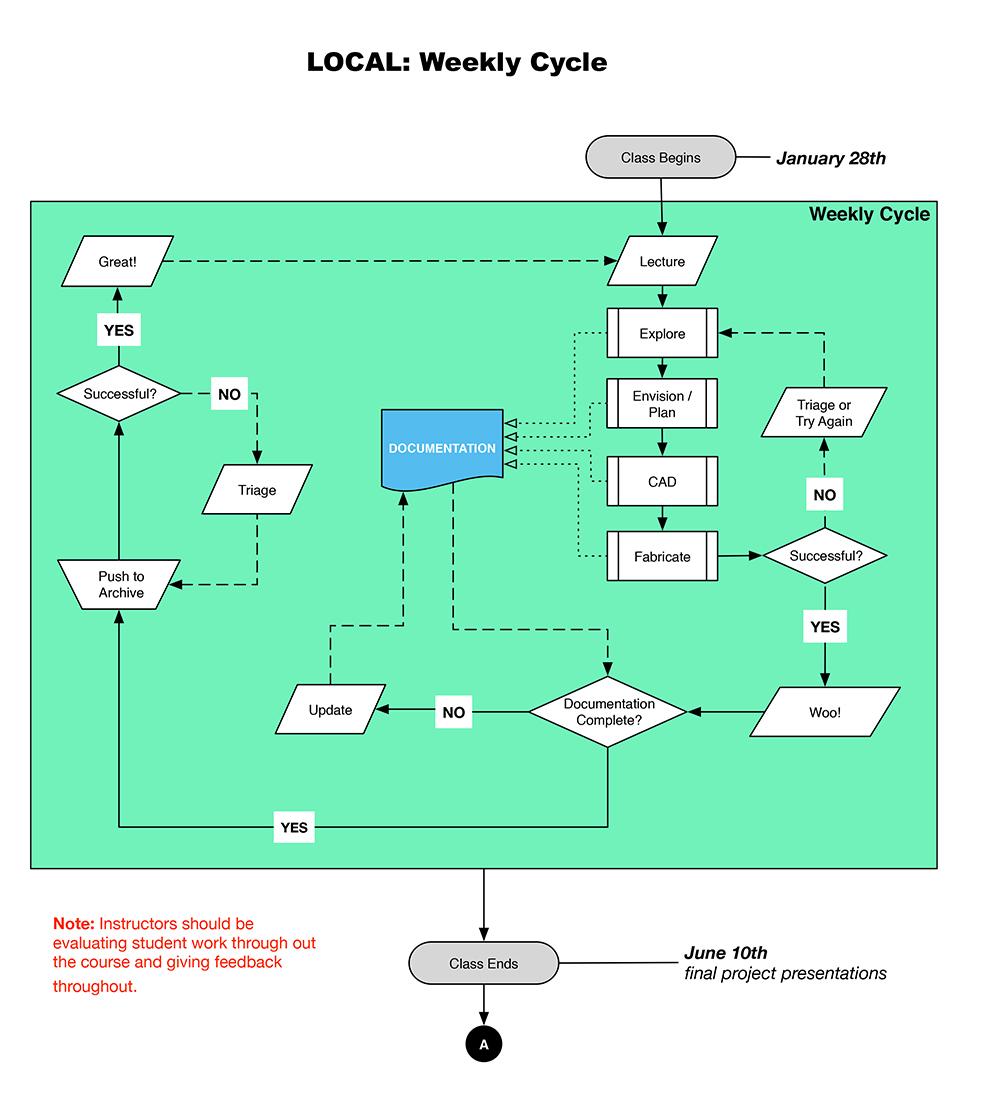
From the Fab Academy Handbook (accessed 9 February, 2017)
Documentation
FabAcademy is all about designing and prototyping. Learning new skills on the fly from people around the world and online resources. With large amounts of information exchanged and numerous iterations of design and fabrication, a solid documentation of the process becomes the most vital part to make this experience productive.
Guidelines
Documentation is not meant to show that you did something, but how you did it and what you learned. It should clearly showcase your understanding of the process and empower reproducibility of results by people from around the world. Documentation to be made as a website and hosted on FablabBombay's Fab Academy Git Archive.
Required Documentation
Students are required to document their work each week for the unit covered and homework will be reviewed during each weekly class cycle. Your local instructor or remote guru will review your documentation in detail every week to make sure you are not falling behind.
Your Fab Academy documentation must show completion of the unit and core skill competencies. It will be in HTML format and must be able to exist within a GIT archive.
At minimum, the Global Evaluation Committee expects a student’s documentation to include:
A text description of their project for the week
designing and fabricating the work
Supporting photographs (video is great, but not required).
All final fabrication files in their original, editable formats
All code in an editable format, testable format
What the student learned: what succeeded and what failed.
It is recommended that students choose a licence for their work prior to the start of publicly posting their files. ie:Creative Commons
Best Practices
- Find a good clean place to work and take photographs.
- Always provide a description for the photos.
- Videos should be hosted on Vimeo.
- Link all final design and fabrication files \(larger than 1MB\) in their original, editable formats and host them on Google Drive.
- If you have referenced any research or ideas, make sure you provide proper citation for them.
- Clearly layout the safety guidelines and risks involved.
Great examples of documentation
Green FabLab - 2015
Anna Aflalo - 2015
Alejandra Diazdeleon - 2014
Time Management & Group Work
To be filled...
The Final Project
FabAcademy terminates into a project which is an amalgamation of the various skills and technologies explored during the course. This gives the perfect opportunity for developing a product that makes life better for you at work, home or in general.
In the first week you start on with conceptual ideas that you can keep in the back of your mind while exploring fabrication techniques during the course and build it at the enb. The other way can also be to develop a strong hold on the concept at the beginning and use the various modules to start making your final product. It's completely acceptable that the project presented at the beginning to evolve and even change during the course of FabAcademy.
The Goal
To be filled...
Things to keep in mind while deciding on the final project
It should be your own design. It can be an improvement over an open source design too.
The product should include an input device and an output device.
The designed product should include 2D and 3D design elements.
Product components should be prototyped with at least two more fabrication process other than PCB fabrication.
Arduino, raspberry pi and other commercial boards can only be used as an extra component and wont be evaluated. For more information refer to the commercial board policy.
Great Examples of Final Projects
Green FabLab - 2015
Anna Aflalo - 2015
Alejandra Diazdeleon - 2014